
Cybersecurity recruitment in business is becoming one of the most critical challenges for organisations today. Yet most hiring problems don’t start with technical skills. They start much earlier, in how “good” candidates are defined and how hiring decisions are made under pressure.
Once that definition of the ideal candidate is set, it quietly shapes every stage of the tech hiring process, often limiting access to stronger talent without organisations realising it.
In cybersecurity recruitment and tech hiring, decisions are rarely fully objective. They are made under uncertainty. Cybersecurity is fast-moving, complex, and high-risk, so the brain naturally tries to simplify the process. It relies on familiar signals such as years of experience, job titles, recognised companies, and specific tools.
While these criteria are common in talent acquisition and HR hiring strategies, they do not always reflect real capability in cybersecurity roles or broader tech talent.
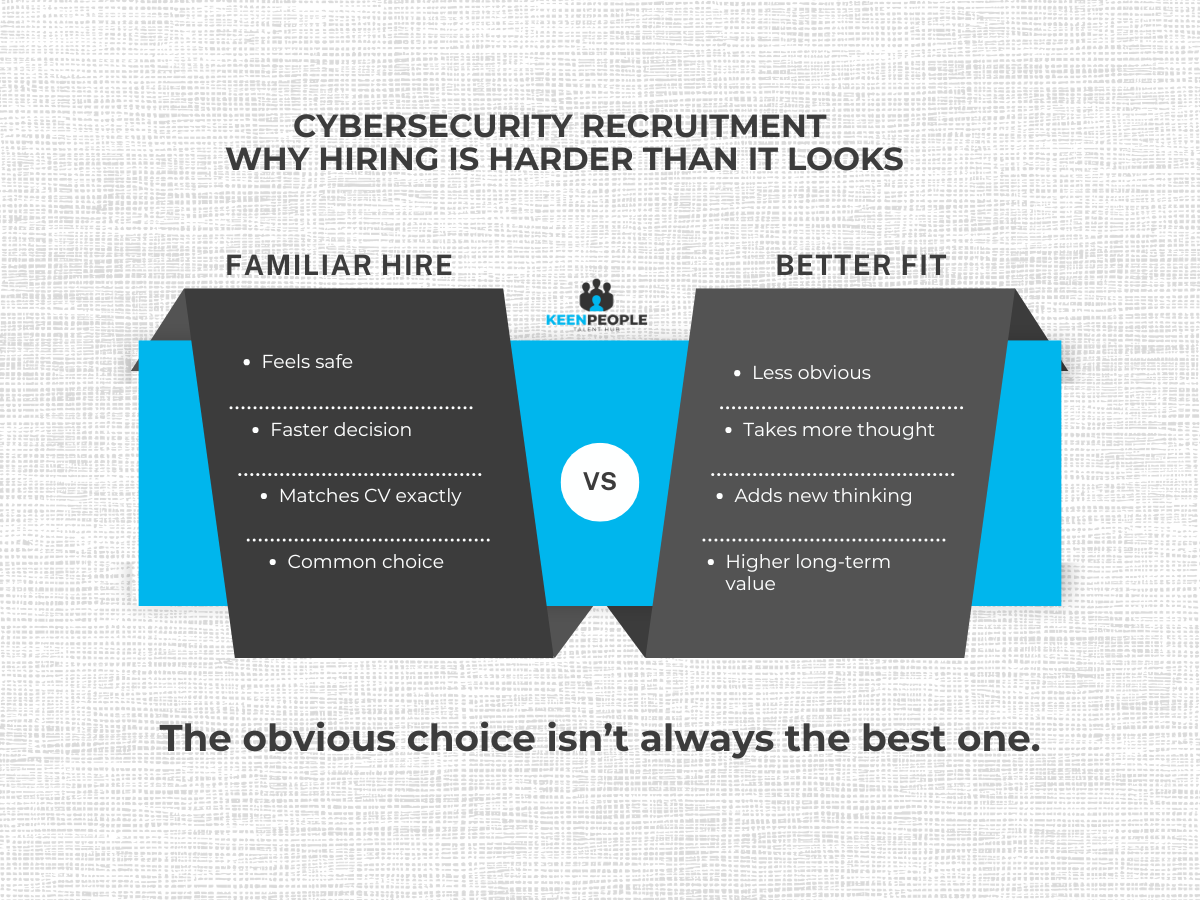
One of the biggest hidden issues in cybersecurity hiring is that familiarity often wins over suitability. When a candidate looks familiar, hiring decisions feel easier and faster. When they do not match the expected profile, hesitation increases. Under pressure, that hesitation often leads to strong candidates being filtered out too early, not due to lack of ability, but because they do not match the mental model of the “perfect hire”.
The reality is that cybersecurity talent is rarely linear. Many of the strongest cyber security professionals do not follow traditional career paths. They move across IT roles, build skills independently, and develop expertise through problem-solving rather than structured progression. On paper, this can look inconsistent, but in practice it often signals adaptability, which is one of the most valuable traits in cyber security teams.
Pressure also plays a major role in recruitment and selection. Most cybersecurity roles are filled in urgent conditions. Teams are under-resourced, projects are delayed, or cyber risk exposure is increasing. Under these conditions, talent acquisition becomes more reactive. Decision-making shifts towards what feels safe and familiar, which can lead to hiring drift. Small compromises or overly rigid requirements that feel justified in the moment but create long-term misalignment in the team.
Another common challenge in tech recruitment is the assumption that confidence equals competence. In interviews, confident candidates often stand out in the hiring process. They communicate clearly, answer quickly, and present certainty. This creates a strong impression in HR and hiring manager evaluations. However, in cybersecurity jobs, some of the most effective professionals are more measured. They think carefully before responding, question assumptions, and prioritise accuracy over speed. These traits are less visible in traditional interviews but are often critical in real-world cyber security environments.
When analysing high-performing cybersecurity teams, a clear pattern emerges. Successful teams rarely consist of identical profiles. Instead, they are built from diverse thinking styles, mixed career backgrounds, and varying levels of experience. This diversity creates resilience, stronger problem-solving, and better risk management in business cybersecurity operations.
This does not usually happen by chance. It happens when hiring decisions in tech recruitment move beyond surface-level matching and focus on capability, adaptability, and long-term contribution to the team.
A more effective approach to cybersecurity recruitment and talent management starts with a different question. Instead of asking who fits the job description, organisations should ask what thinking is missing within the team. This shift moves hiring from replication to capability building, strengthening cybersecurity strategy rather than simply filling vacancies.
Cybersecurity recruitment in business is not only about finding candidates with the right technical skills. It is about understanding how hiring decisions are influenced by familiarity bias, urgency, and perception. In most cases, the strongest hire is not the candidate who matches perfectly on paper, but the one who adds something the team is currently missing.