
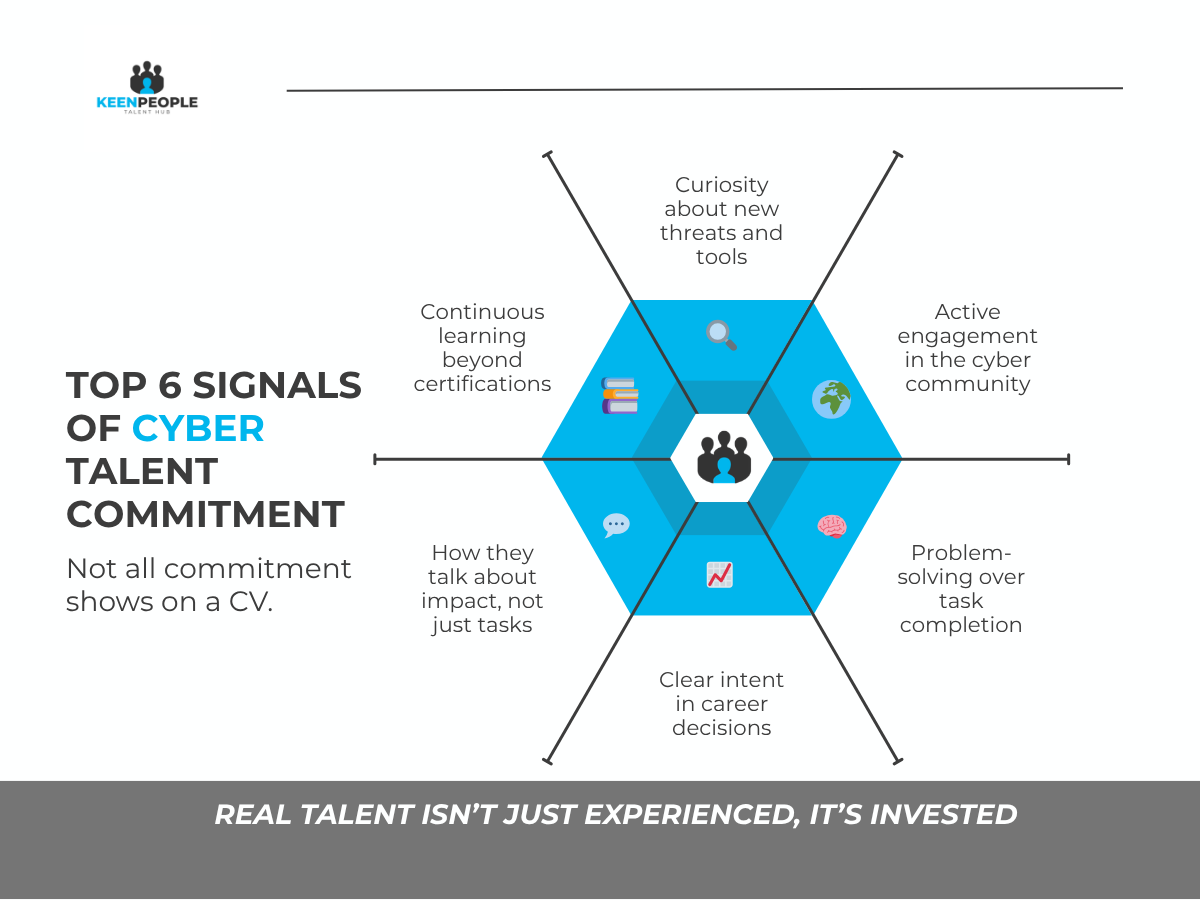
In cybersecurity and technology recruitment, employers often say they want candidates who are “committed to their profession” and have invested in developing advanced knowledge.
But in practice, that commitment is not always easy to measure.
CVs show experience. Certifications show training. Job titles show progression. Yet none of these fully capture the depth of a professional’s engagement with their field.
In a competitive cyber and tech talent market, understanding the real signals of commitment has become essential for better hiring decisions.
One of the most reliable indicators is continuous learning that goes beyond mandatory requirements. Candidates who actively invest in advanced certifications, specialised training, or independent study are demonstrating more than technical ability. They are showing curiosity, discipline, and long-term intent within their profession.
However, learning does not only appear in formal qualifications. In cybersecurity especially, some of the strongest signals come from behaviour rather than credentials. Professionals who engage with industry developments, follow evolving threats, and apply new knowledge to real-world scenarios are often more committed than those who rely solely on static qualifications.
Another important signal is contribution to the wider cyber and tech community. This might include sharing knowledge, participating in discussions, contributing to open-source projects, or engaging with professional groups. These behaviours indicate that a candidate is not only developing themselves, but also actively investing in the growth of the field itself.
Consistency in career development is another key indicator. While career paths in cybersecurity are often non-linear, there is still a difference between purposeful movement and reactive movement. Candidates who make deliberate decisions to expand their expertise, even across different roles or disciplines, often demonstrate stronger long-term commitment than those who change direction without clear development intent.
It is also important to recognise how candidates talk about their work. The way professionals describe their experience can reveal a great deal about their level of engagement. Those who focus on problem-solving, learning outcomes, and impact tend to show deeper connection to their profession than those who simply list responsibilities or tools.
For employers, especially in cybersecurity recruitment, this matters because technical skills alone are not enough. The threat landscape changes constantly, and professionals who are genuinely committed to their field are more likely to adapt, learn, and grow with those changes.
This is where traditional hiring methods often fall short. Over-reliance on keywords, certifications, and job titles can mean that highly committed individuals are overlooked simply because their experience does not follow a conventional pattern. At the same time, candidates with strong credentials but low engagement may appear suitable on paper but lack long-term adaptability.
Understanding these signals allows organisations to improve the quality of their hiring decisions. It shifts the focus from static indicators of capability to dynamic indicators of intent and commitment.
In cybersecurity and tech, this distinction is critical. The most successful teams are not just built on experience, but on continuous development, curiosity, and genuine investment in the profession.
Ultimately, commitment is not something that can be fully captured on a CV. It is demonstrated through behaviour, mindset, and ongoing engagement with the field.
And in a sector where change is constant, those signals are often what separate good candidates from great ones.